Subscribe to Facebook posts:
 
Picture
II Kigs.7:2, "Then a lord on whose hand the king leaned answered the man of God, and said, Behold, if the LORD would make windows in heaven, might this thing be? And he said, Behold, thou shalt see it with thine eyes, but shalt not eat thereof."

On new year's day a good friend ministered on these chapters which contain this verse. It relates to this subject of coming revival in a most vital and personal way.

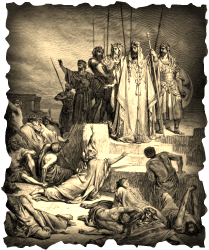
We are told in chapter 6 that the King of Syria came up with a great army and besieged the city of Samaria. In verse 25 we read: "And there was a great famine in Samaria: and, behold, they besieged it, until an ass's head was sold for fourscore pieces of silver, and the fourth part of a cab of dove's dung for five pieces of silver."

An ass was an unclean animal to the Jew but things are so bad in this famine that they not only were buying and eating it, but they were eating its head. The head was the cheapest part. And as if that was not bad enough it was being sold for the crazy price of 80 pieces of silver. Dove's dung was being sold for 5 pieces of silver. When Christianity is besieged, in famine, with no sign of revival, then God's people eat anything at a very high price. When the Dove who brings and leads revival is gone His dung is very costly!

At this disastrous point of the siege as the King walked about the walls surveying the scene of his beleaguered people a woman cried out to him for help. The sad story then unfolds before the King concerning two mothers with babies who agree to cook and eat their children. The first mother carried it out but the second would not. She hid her child (v26-29). When no revival comes to God's people this is the tragedy which takes place. Have you not been sickened to the stomach by what you have seen go on in so-called churches amongst believers? Why is that? It's because there is a famine, there has been no rain, the enemy has exalted himself in besieging the church.

When the King heard this he was so sickened by it that he rent his kingly garments and went onwards in sackcloth and ashes. Anger filled his heart which he turned against Elisha who was God's prophet in their midst. The King swears that that very day he would take Elisha's head. When the King came to Elisha blaming the Lord for this tragic state of affairs Elisha responded by prophesying of coming deliverance. Within 24 hours they will have more than plenty. "Thus saith the LORD, To morrow about this time shall a measure of fine flour be sold for a shekel, and two measures of barley for a shekel, in the gate of Samaria."

A lord who was at the King's side responded to this word of the prophet: "Behold, if the LORD would make windows in heaven, might this thing be?" Here was a statement of utter disbelief. The tragic famine had blinded his eyes to the hope of a coming change in the city and his heart had become so encrusted that it could not believe that God could or would do such within 24 hours.

The prophet responded: "Behold, thou shalt see it with thine eyes, but shalt not eat thereof." This is a stark warning to believers who have become so discouraged with the famine, the enemy, and even the state of God's people they have no faith that God will again bestir Himself, reveal the power of His right hand and deliver His people once more by mighty revivals and visitations. It is a terrible thing when believers forget how powerful God is and limit the Holy One of Israel in what He can do. There will be those in our midst who will only see revival afar off but will not live long enough to enjoy it. 

So close to revival yet so far. All because of unbelief. What was the means by which God brought this amazing and sudden deliverance? It was through four lepers who reasoned "Why sit we here until we die?" God honoured their faith and their willingness to not die without a testimony. In this hour of famine are you like the lord who died of unbelief or the lepers who lived because of faith?

 
 
Picture
"Be patient therefore, brethren, unto the coming of the Lord. Behold, the husbandman waiteth for the precious fruit of the earth, and hath long patience for it, until he receive the early and latter rain." James 5:7

In the previous note we stated that the former and latter rain was prophetic typology used to signify outpourings of the Holy Spirit upon the Church in the New Testament dispensation. Lest someone should think that this is an incorrect recent interpretation let's look at how this was applied in the New Testament Scripures through apostolic doctrine.

James lived after Pentecost in the latter part of the first century when there were signs of declension in the church. James prophesied concerning days which  "shall come" (v1) and of the "last days" (v3). He went on to speak of that part of last days proceeding "the coming of the Lord" (v7). In this one simple verse as well as this chapter he not only sets forth typology but sound doctrine. He shows that "the former and latter rain" are connected to four things, 1) last days, 2) the Church age,  3) spiritual harvest, 4) and the Person of Christ in His enthroned ministry and His return for His Church.

1) Last days. This is still the period spoken of by Joel, Peter and others as being a time when the Lord would send revivals. We are still in that era which began at Pentecost. The "former and latter day rain" is particularly connected to the "last days." It is a part of last days. Revival has been prophesied for last days. After Pentecost Peter certainly believed that "times of refreshing" would continue to be granted "from the presence of the Lord;" until Christ would return (Acts 3:19-21). We should believe it, look for it, expect it and pray for it.

Last days is a time when many prophesies will be fulfilled and come to pass. Sadly revival as the work of Christ is forgotten in this context while all other end day events are talked of. James inserts just one of these as an indication of the days in which this latter rain revival will come in fullness. He speaks of a terrible international ecomonic crisis that will deeply impact the rich of the earth. These rich men will have "heaped treasure together for the last days" (v3). These treasures are noted in particular to be gold and silver. There is an hour of judgement coming upon these rich men who have caused misery and heardache in their gathering of wealth. Zechariah chapter 5 also speaks of such a judgement near the end.

2) Church Age. The former and latter rain is connected to the Church not just OT Israel. Revival is a Church word. This rain is for God's people. The "former rain" was first granted to 120 praying disciples in an upper room in Jerusalem. All of the early outpourings recorded in Acts were primarily for those who believed on Christ. When God's people are tired, weary, partched, thirsty, discouraged and even disparing there is a rain which God will send which will revive them (Ps.68:9; Isa.32:15). While there is a Church on earth the promise and hope of revival is held out to that Church for its encouragement. The Lord will yet grant latter rain rain outpourings to His Church. He has not forsaken her. This rain is a part of the Lord's wonderful provisions for His Church. Please never think of the Church apart from this provision of rain. The Church was birthed in rain. Why should we think it starnge to expect it to finish its course amidst a mighty deluge?

3) Spiritual Harvest. We see that this former and latter rain brings in the "precious fruit of the earth." Without the rain there is a spiruitual harvest which shall not be reaped. The result of the former and latter rain being granted to the Church is for the purpose of producing a spiritual harvest. Every time the rain came in the Book of Acts many souls were saved and added to the church. From the first mention of the "first and last" rain in the Bible it is granted with the purpose of enabling God's people to gather in the harvest (Deut.11:14; Jer.5:24; Zech.10:1). In this last mention of the former and latter rain in the Bible it is in reference to the fruit of the earth - this is not natural fruit but spiritual fruit. It is a last great ingathering of men and woman into the kingdom in salvation before the end.

4) Christ. These seasonal outpourings of the Holy Spirit are vitaliy connected to the person of Christ. The first rain that fell at Pentecost was the result of Christ being exalted to the right hand of the Father (Acts 2:32-33). In that position He poured out the Spirit as the former rain. The sending of the former and latter rain is a part of His enthroned ministry. For as long as He is at the Father's right hand there will be outpourings of the Spirit (Rev.5:6). Every revival is a part of Christ's continuing ministry. He will yet again pour out the Spirit upon the Church before He comes.

This former and latter rain is connected to His return. This latter rain must come in fullness before He comes for the harvest. When James says "Be patient brethren"
concerning the return of Christ he gives the reason. Christ has "long patience"  because He is waiting for the fullness of the harvest to come in. He will return for a completed Bride - a full harvest. At the end of the seasonal rains and showers which have brought it in fully He shall then come for it. And so he exhorts "Be ye also patient; stablish your hearts: for the coming of the Lord draweth nigh" (v8). We should not only see apostasy, darkness and declension as signs that Christ is about to come. If you really believe Christ is about to come then you should expect a reviving of your spiritual life and to see souls saved.

"Ask ye of the LORD rain in the time of the latter rain;" (Zech.10:1). Friends it is time to ask, pray, plead and interceed for this latter rain. It is the time of latter rain. It is the end of the age, the end of harvest time. Jesus is about to come. We must discern that it is the time of rain or for rain and so in obedience to God's Word "ask." If we do not recieve rain now a whole generation will go to Hell


Picture
When the revival at Pentecost came it marked the beginning of the last days. Of this revival Peter said: "this is that which was spoken by the prophet Joel;" (2:16). 

what Joel spoke of was a period during which the Holy Spirit would be outpoured. Peter was saying this is the beginning. These outpourings would end with what is called "the day of the Lord" which is the day of the Lord's return. Joel speaks of this event frequently and it is central to his whole prophetic message (1:15; 2:1-2, 11, 31; 3:14, 18). It is a day of wrath and judgement for sinners but a day of salvation and reward for the righteous. 

It is in the context of this day and prior to it that he speaks of the outpouring of the Spirit which would begin to be fulfilled at Pentecost. Joel exhorts God's people to repentance, prayer and fasting as the pathway to these outpourings. What we see at Pentecost is a taste of the type, manner and power of the outpouring of the Holy Spirit which would be granted to God's people throughout the church age. 

Joel along with many other Old Testament prophets spoke of such outpourings. Throughout the OT these outpourings are likened to the coming of rain. When the Lord speaks of His coming to His people in revival in order that a great harvest of souls may be brought in He often typifies it by the former and latter rain (Deut.11:14; Job 29:23; Prov.16:15; Jer.3:3; 5:24; Hos.6:3; Joel 2:23; Zech.10:1; Jm.5:7). This cannot be more clearly stated than by Hosea: "...he shall come unto us as the rain, as the latter and former rain unto the earth."

In Joel in connection with the prophecy concerning the revival which would later begin at Pentecost Joel says: "for he hath given you the former rain moderately, and he will cause to come down for you the rain, the former rain, and the latter rain in the first month." 

If we look for a moment at Israel's rainy season we shall understand better what the Lord was saying. Rain fell in two seasons.

1. "the Former rain" (first) Autumn rain. In national Israel the rainy season begins about September time. The period from September to December is called "the former rain" although the main rainfall is usually in October and November. The husbanbman (farmer) watches for the first sign of coming rain so as to be sure the seed is well planted in the ground. It begings gently but turns into heavy rain which prepares the ground and makes the seed to take root and germanate. As a result of the former rain a harvest grows up.   

2. "the latter rain" (last) Spring rain. The rainy season finishes with a "latter rain" beginning in February through till April which is granted by God in order to ripen the harvest which began with the former rain. This last rain is the final preparation before harvesting. It is vital to the whole process of harvest and to complete the work begun in the former rain. Both are necessary for a full healthy harvest. 

The harvest at its beginning and again at its end was marked by a deluge of rain. But between these two vital points the rain never totally ceased. Between December and February it rained lightly at intervals.

When the OT prophets spoke of the Lord coming to them as the former and latter rains it was filled with meaning. The early Church fully understand the same meaning from the same Scriptures. Seed time and harvest depended upon rain. Both naturally and spiritually the sowing of seed and the reaping of harvest needed the rain. 

For the New Testament Church the first rain and first harvest and ingathering came on the day of Pentecost. This was the "former rain" which prepared the ground and brought forth the initial harvest. This heavy rain continued throughout the first century. Since then there have been showers at intervals. Beginning in the 16th century with the Reformation the showers have got stronger as we have moved towards the final harvest. This latter deluge gave us the 18th century Methodist revival, the 1859 revival, the 1904 revival and the Pentecostal revival. The two great periods of revival have been in the early church and again in recent centuries. 

But Joel seems to say a strange thing. After talking of the first rain he goes on to say that the Lord will cause to come down: "the former rain, and the latter rain in the first month." The first month was Nisan which is our March/April time. This is at the very end of the raining cycle on the eve of harvest. Joel does not just say that the latter rain will come then the harvest, but states that the latter rain will come then 'the former and latter rain' will be given together at this time just before the harvest. Joel certainly was not talking of the natural cycle. This was a spiritual promise. Does this mean that the end of the Church age will recieve not only the former rain but the latter rain together in the same month? Is this prophecy showing us that we will see the Pentecostal revival of the 1st century as well as the latter rain seen in recent centuries suddenly come together in one last revival?

Before the day of the Lord, the day of Christ's return, we are promised latter rain in order to bring in the last harvest. This revival comes in one month in order to bring in one great last harvest just before the judgement of God falls upon the world when He will pour out His wrath in an unparalled way. Would it seem strange that He sends the greatest revival just before the greatest judgement the world has ever known?


Picture
Lk.18:8, "Nevertheless when the Son of man cometh, shall he find faith on the earth?"

This scripture is well known, well quoted and well used by those who believe that when the Lord comes He will scarecly find saving faith on the earth. They believe there will be very few with true faith in Christ at the end. If this is true then we can hardly expect revival in such days.

While it is true that Christ always contrasted between the "few" and the "many" this is not what this Scripture means. It is not talking about salvation or saving faith. So what is it talking about or what did Christ mean? 

First of all Christ is not stating a fact but asking a question. Also the context of this verse is concerning prayer. The previous seven verese are about prayer. In verse 1 it says: "And he spake a parable unto them to this end, that men ought always to pray, and not to faint;" So the whole point of the parable which He then relates is concerning praying and not fainting. The parable is about the persistent widow seeking vengence from the unrighteous judge. It was only because of her persistent prayer that he answered her. 

Then Christ says: "And shall not God avenge his own elect, which cry day and night unto him, though he bear long with them? I tell you that he will avenge them speedily." What a promise.

Then He asks His question: "Nevertheless when the Son of man cometh, shall he find faith on the earth?" He is asking 'When He returns will He find this type of faith.' A faith thay lays hold of God and will not let go. A faith in prayer that cries out for vengence night and day against the enemy. A faith that will not faint in prayer. 

Because of the darkness and deception of the last days many true believers who are truely born-again will grew weary, tired and faint. Christ is asking 'In this hour are you going to pray night and day asking for vengence against the enemies of your soul?' This little widow is an example to the end day Church to arise and pray, arise and believe, arise and prevail. 

Will the Church of the last days just slump down under the darkness and barely scrape through or will she arise and pray? Why does the Lord put such a question to us? Because there is much He wants to do in the last days. There are prayers He wants to answer. I believe that one thing He has promised in this last hour is a last genuine deluge of latter rain in order to bring in one last harvest of souls before His judgement is poured out on the nations. But where are the saints who will prevail against the darkess, discouragements and apathy of this hour in order to ask for such until it comes? 

When revival comes His enemies tremble at His presence. Revival is God's vengence on the enemy. Revival shatters the power of Satan, his kingdom and his binding, destroying work which has moved forward undeterred for years and generations Isa.37:20; Ps.102:15-16. We must ask for vengence against the adversary and look for a Holy Ghost revival that will bring deliverance to multitudes.

So far from being a deterrent from expecting revival our text is an encouragement to pray for such.
 
Lastly He says "though he bear long with them" He will "avenge them speedly." The night may seem long, the delay continual, the enemy wicked, the situation worsening, but hold on Saints of God He will suddenly, speedly, dramatically, completely answer and avenge us of the enemy.


Picture
About 15 years ago I preached a message called The But's of Revival. This was in response to hearing a number of very genuine believers quoting scriptures to show that before Jesus returned it would be extremly dark in the world with no general harvest of souls and no sign of revival in the Church. One day I took these various Scriptures and laid them before the Lord in prayer and study. Amazingly I found a "But" attached to each dark forbodding prophesy. When you do see the darkness of the last days it is impossible to think the Church will survive without a genuine spiritual revival which will make them wax valiant. The Lord has always in revival to His Church at the darkest times. Here is a sample and summary of what I preached in that message and of what the last day church will look like.

1st BUT OF REVIVAL

Mat 24:11-12, "And many false prophets shall rise, and shall deceive many. And because iniquity shall abound, the love of many shall wax cold." This is a dark prophesy given by Christ Himself concerning the days before His return. False prophets in the Church will cause many to roam (Rome) from the truth. There will be a rebellion against the written Word. A cold wind will blow strongly in these last days which will be aimed at the agape love of the Church. Most (many=more than half) will grew cold. Thank God He did not end there.

Mat 24:13-14, "But he that shall endure unto the end, the same shall be saved. And this gospel of the kingdom shall be preached in all the world for a witness unto all nations; and then shall the end come." He also prophesied that in the midst of such a trying time there would be a people who would hold fast and endure through to the end. But this enduring people are not just holding on hoping to make it through dark days to the end or to escape in the rapture. This enduring people are preaching. They are preaching a pure Gospel message in each nation for a "witness." What is a witness? The only example we have is the example of the early Church in the Book of Acts. When the Holy Ghost came upon them they became a "witness" as displayed in Acts and went forth to preach to every creature in every nation. This will again be seen at the end of time.

2rd BUT OF REVIVAL

This chapter is indeed a dark prophesy concerning the state of things prior to Christ's return to earth. II Thess.2:11-12, "And for this cause God shall send them strong delusion, that they should believe a lie: That they all might be damned who believed not the truth, but had pleasure in unrighteousness." This delusion will sweep our world at the end just before Christ returns. Only those who believe and love the Word of God will be protected and preserved in this terrible "delusion." Mr Strong explains that this word means 'a straying from orthodoxy or piety.' Mr Young says it is 'a mental straying in holding the wrong opinion.' The delusion is a being moved from and carried away from the sound doctrine of Christ. 

II Thess.13, 15, "But we are bound to give thanks alway to God for you, brethren beloved of the Lord, because God hath from the beginning chosen you to salvation through sanctification of the Spirit and belief of the truth...Therefore, brethren, stand fast, and hold the traditions which ye have been taught, whether by word, or our epistle." This "But" is given in the light of such terrible departures from truth. But there will be a real Church on the earth - chosen, saved, believing the truth, sanctified and standing fast. While many are moving away from truth many are standing fast who still love and believe the Gospel which was preached by the apostles and handed down to us in the Scriptures. 

3th BUT OF REVIVAL

II Tim.3:12, "Yea, and all that will live godly in Christ Jesus shall suffer persecution. But evil men and seducers shall wax worse and worse, deceiving, and being deceived." While saints suffer sinners wax worse. It is percieved by many that decievers and deception will get far worse in the last days and that is indeed true. Men who will use seductive arts in decieving and drawing men from Scriptural truth will drive forward and advance in this cause going deeper in deception themselves. 

In the light of this Paul instructs young Timithy in II Tim.3:14-15-16, "But continue thou in the things which thou hast learned and hast been assured of, knowing of whom thou hast learned them; And that from a child thou hast known the holy scriptures, which are able to make thee wise unto salvation through faith which is in Christ Jesus. All scripture is given by inspiration of God, and is profitable for doctrine, for reproof, for correction, for instruction in righteousness..." Paul was assured that although such wicked men would grew in deception yet men like Timothy would remain faithful to the written Scriptures which had brought salvation in Christ Jesus to them. There will be a people who grew in their knowledge of written Scriptures throughtout their walk with God and by this means will come to maturity and perfection.

4th BUT OF REVIVAL

Isa.60:2, "For, behold, the darkness shall cover the earth, and gross darkness the people..." In chapter 59 we see truth fallen in the streets and iniquity abounding. Here in this verse what a terrible, thick darkness covered the land and people.

"...but the LORD shall arise upon thee, and his glory shall be seen upon thee." Darkness on the land but not on God's people. In such an hour when gross darkness covers the land then at that very time the Lord will arise upon "thee" and His glory be seen on "thee." This is at a time of terrible darkness. Revival is the Lord Himself arising upon His people.

CONCLUSION

Amidst encreasing deception, apostasy, darkness and a terrible departure from the written Scriptures revival will come to the true Church. She will revive, wax valiant, put on glory, trim her lamps, preach the Gospel, stand fast unmovable upon the truth of God, and will gather out a last harvest.


Picture
We all know well that Joel prophesied concerning a mighty outpouring which started in Jerusalem on the Day of Pentecost. The fullness of this outpouring prophesied in Joel is that “I will pour out my spirit upon all flesh;” that means it will be international in touching every people group. That never happened in its entirety at Pentecost.

This prophesy was not fulfilled at Pentecost or in the Book of Acts.

These outpourings would now be the mark of the Church age. Pentecost was a beginning not a complete fulfilment. This promise and the beginning of its fulfilment at Pentecost pointed to a future, further and fuller outpouring of the Holy Spirit. This was the beginning of such revivals which would continue throughout church history until the day of Christ's literal, physical and visible return to the earth (2:19-20). That means we are still in that time period.

Joel prophesied: “And it shall come to pass afterward that I will pour out my spirit upon all flesh; and your sons and your daughters shall prophesy, your old men shall dream dreams, your young men shall see visions: And also upon the servants and upon the handmaids in those days will I pour out my spirit." (Joel 2:28). Joel was looking forward in time to a period that would be marked by outpourings of the Spirit.

On the Day of Pentecost when asked the meaning of what was happening Peter responded by quoting Joel. He said: “And it shall come to pass in the last days... (Acts 2:17). So this period called "last days" was to be marked by outpourings of the Spirit. "Last Days" is not a short period of time before Jesus returns but is a long period of time which began on the Day of Pentecost and which stretches forward to Christ's return.  
 
This word "last" is the word eschatos which means - farthest, final, ends of, last, latter end or uttermost (Jn.6:39-40, 44, 54, 11:24; 12:48; Acts 2:17; II Tim.3:1; Heb.1:2; Jm.5:3; I Pet.1:5, 20; II Pet.3:3; I Jn.2:18; Jude 1:18). Revival should be a vital part of eschatology (the theological teaching of what happens during the last days). The Bible clearly predicts that these outpourings will never come to an end while there is a Church on earth. Revival is a Church-word. In other words you can never think of the term revival apart from the Church and should never think of the Church apart from the potential of Revival. Never has a revival in history come without it coming to and through a portion of God’s Church.

Until the rapture of the Church there will be such revivals. Both Joel and Peter state three clear "last day" incidents which bring to an end that period of outpourings commonly called revivals like that seen in the Book of Acts and which we have experienced throughout Church History. 

1. “...wonders in heaven above, and signs in the earth beneath; blood, and fire, and vapour of smoke:”

 2. “The sun shall be turned into darkness, and the moon into blood,” – A cosmic blackout. This is literal as clearly seen and taught in a number of Scriptures (Isa.24:23; Amos 8:9; Mt.24:29; Mk.13:24; Lk.21:25; Rev.6:12). 

3. “...before that great and notable day of the Lord come:” When Christ stands upon Mt. Olivet and comes in judgement on the nations.

Until these three incidents come to pass we cannot say the day of revivals has passed us by. Peter recieved his doctrine of revival from the Old Testament Scriptures. To his mind revival was a solid biblical issue; not a feeling, impression or
even experience. The strongest arguement for future revival is the written Scriptures. Peter's conviction and belief concerning future outpourings of the Spirit was founded, grounded, gaurded and upheld in faith by the Word of God.

Again while Peter is preaching in chapter 3 of Acts he gives us four important words: repent, refreshing, restitution and send (return). These four words span a period from Peter's preaching of repentance to the time of Christ's return. But he explains that between these two points of time that there will be seasons of revival.

"...when the times of refreshing shall come from the presence of the Lord;" This word "refreshing" means recovery of breath or revival. Peter says there will be "times" of revival. This word "times" means set periods of time. So he is saying that there will be ‘certain set periods and seasons of revival.' 

He also says there will be "the times of restitution of all things, which God hath spoken by the mouth of all his holy prophets since the world began." This term restitution means restoration; to restore back to order. So there will be continual "times" of revival and times of "restoration" of things spoken of by the OT prophets and these will continue "until" the Father "shall send Jesus Christ."

It is also clear from this that these "times" are not continual without break. Between these "times" there will be apostasies, dark times and times in which the Lord's people despond. Yet on the back of such times the Lord will revive and restore  until Christ returns. No one can biblically say that there will be no future or further revivals or restorations of the Church to a glorious state without departing from the prophetic Word of God and from the promises of Scripture.


Picture
In our Western society with its spiritual coldness and apostasy there is always the danger for real believers to become convinced that all that awaits us in the future is deeper darkness, greater deception and the rapture.

Let me say a few words to those who are convinced that there will be no future revival for the Church. First of all I am so very glad that those who held such sentiments before the 1859 revival turned out to be terrible wrong. Before this revival there were those who taught that it was going to get worse and worse and that they were now in the Laodicean age. Im also glad that those who held such sentiments before the 1904 revival were also wrong.

I once read the testimony of William Williams concerning a little prayer group in Wales who became so discouraged with the spiritual climate and with no answer to their prayers for revival that they finally decided to close the small prayer meeting. On that last night as they gathered to pray and with the purpose of then locking the door a dark cloud hung over their heads. But as the prayer meeting drew to an end the Lord came down in mighty power on these desponding souls in such a mighty way that this was the beginning of a genuine mighty prolonged revival that swept multitudes into the kingdom of God.

The history of revival proves one thing: the Lord very frequently came in such a manner, in a very dark and unlikely hour, to a remnant people who had almost lost hope. This has most often been the Lord's rescue plan.

So please understand this. Many times God's true people thought they had passed the day of revival. Many times the Lord has surpried His people. Many times the Lord has utterly shattered and destroyed the enemies of the Gospel at a time when it seemed all was lost.

In the light of this we aught to be careful to return to Scripture to find what is revealed of the heart, mind and purpose of God concerning revival. The Lord may well come and do in the Church very shortly great and mighty things which we have never known or experienced, and which most have not looked for or expected.

Jer.33:3"Call unto me, and I will answer thee, and shew thee great and mighty things, which thou knowest not." 

Isa.64:3, "When thou didst terrible things which we looked not for, thou camest down, the mountains flowed down at thy presence."